
You’ve probably heard both terms tossed around like competitors. Are they, though? Edge computing and cloud computing solve different problems, and the wrong pick quietly wrecks your app’s performance or your infrastructure budget.
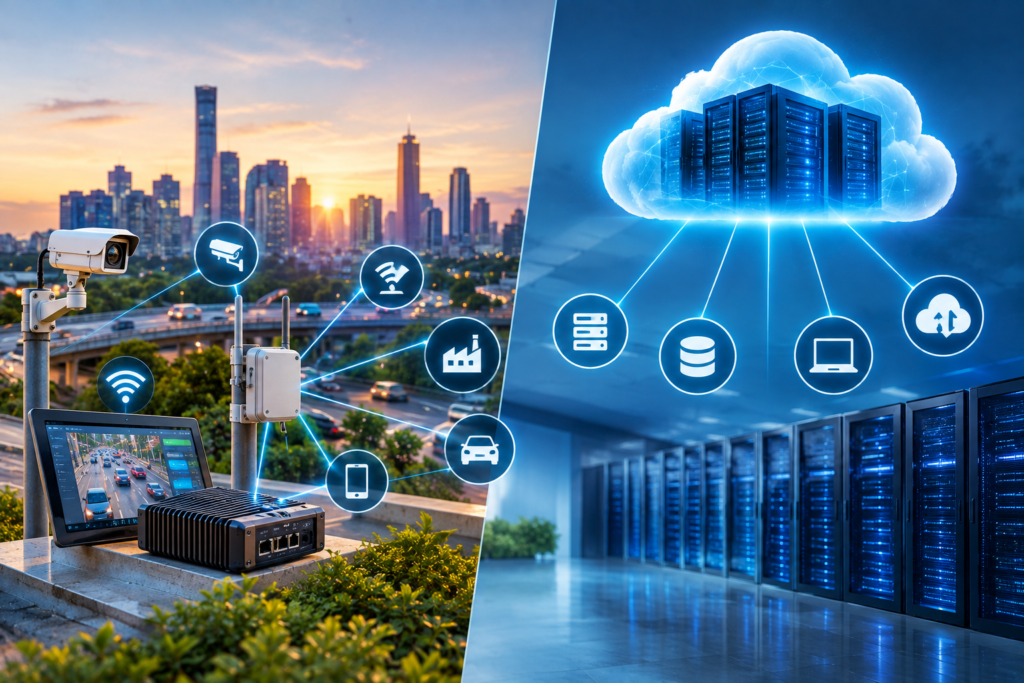
Data location decides everything here. Cloud computing pulls data into massive, centralized data centers for processing. Edge computing pushes processing out to the source — a sensor, a phone, a local server a few feet from the action. That single distinction shapes speed, cost, privacy, and reliability across your entire system.
Cloud infrastructure spending backs up this shift with real numbers. The global cloud computing market reached USD 781.27 billion in 2025. Growth analysts project a rise to USD 905.33 billion in 2026 and USD 2,904.52 billion by 2034. Edge computing climbs just as fast on a smaller base — the market moves from USD 28.5 billion in 2026 toward USD 263.8 billion by 2035, at a 28% CAGR. Both trends keep accelerating. What drives both markets at once?
What Is the Core Difference Between Edge and Cloud Computing?
Location drives the whole comparison. Cloud computing centralizes storage and processing in hyperscale data centers, often hundreds or thousands of miles from the user. Edge computing decentralizes that work instead and runs applications close to IoT devices, gateways, and local servers.
Connected devices make this split urgent. Global connections will exceed 29 billion connected devices by 2030, and a stream of raw data from every device back to a distant center creates real latency and bandwidth strain. Edge computing filters data locally first, then sends only the useful summary upstream.
Bandwidth costs add up fast at scale. A single smart camera that streams raw 4K video around the clock can drain a network budget within weeks. Local processing changes that math entirely, and it changes your latency profile too.
How Do Edge Computing and Cloud Computing Compare Side by Side?
| Feature | Cloud Computing | Edge Computing |
| Primary location | Centralized, hyperscale data centers | Local devices, IoT gateways, nearby edge servers |
| Latency | Tens to hundreds of milliseconds | Single-digit milliseconds |
| Bandwidth usage | High — raw data travels over the internet | Low — data gets filtered and processed locally |
| Offline functionality | Needs a stable internet connection | Runs autonomously without one |
| Compute power | Virtually unlimited, scales on demand | Limited by local hardware |
| Data privacy | Managed by the cloud provider | Stays close to the source |
| Setup complexity | Simpler to deploy | More complex, distributed management |
| Best for | Big data analytics, SaaS, AI training | Real-time decisions, IoT, instant feedback |
Which row matters most for your project? That answer usually points you straight to the right architecture.
When Should You Use Cloud Computing?
Cloud architecture wins when your workload needs raw scale. Heavy workloads such as AI model training, data warehousing, and multi-region data aggregation demand compute power that outpaces local hardware entirely.
Global reach matters here too. A SaaS platform or a service like DigitalOcean’s cloud hosting needs to serve users on every continent with consistent uptime. Centralized infrastructure delivers that consistency far more easily than a patchwork of local servers.
Storage costs favor the cloud too. Long-term storage of historical data costs far less on shared cloud infrastructure than on hardware you own and maintain yourself. You pay only for what you use, and capacity scales the moment demand spikes.
When Should You Use Edge Computing?
Milliseconds matter in some systems, and cloud round-trip times fall short here. Autonomous vehicle sensors, industrial safety shutoffs, and real-time medical monitors all fall into that category. A delay of even 200 milliseconds can cause a real failure in these systems.
Bandwidth optimization is another strong driver. Local hardware keeps video feeds from smart security cameras off the network around the clock, and that switch cuts data transfer costs dramatically. Platforms from Fastly and edge-optimized hardware from NVIDIA make this kind of local processing accessible without custom-built infrastructure.
Connectivity gaps push the decision too. Mining operations, marine shipping routes, and remote farms often lose internet access entirely, and systems built for the cloud fail the moment the connection drops. Edge computing continues to operate regardless.
Data sovereignty rules add a fourth reason. Many regions now require certain data types to stay within a physical boundary, and edge computing keeps that data behind your own firewall by design.
What Are Real-World Examples of Edge Computing?
Concrete examples make the concept click faster than any definition. Here’s where edge computing already runs today:
- Smart traffic systems — local nodes read camera feeds and adjust signal timing instantly, then send only summary data to a central platform.
- Autonomous vehicles — onboard processors handle braking and obstacle detection in milliseconds; the round trip to a data center never happens.
- Retail checkout and inventory — in-store sensors track stock levels and flag shortages before every scan reaches the cloud.
- Industrial IoT — factory-floor sensors detect equipment vibration or temperature shifts and trigger shutdowns before a breakdown happens.
- Healthcare monitors — wearable devices track vitals, flag anomalies on the device itself, and sync summaries later.
- Content delivery networks — cached content sits on servers near the user, and page load times drop before a request ever reaches the origin server.
Do any of these match a system you plan to build? Chances are, at least one does.
What Are the Pros and Cons of Edge Computing?
Weigh both sides upfront, and you sidestep a painful migration later.
Advantages:
- Near-zero latency for time-sensitive decisions
- Lower bandwidth costs, since raw data stays local
- Continued operation during internet outages
- Stronger data privacy through local processing
- Reduced load on central cloud infrastructure
Disadvantages:
- Local hardware caps available compute power
- Distributed devices raise physical security and management complexity
- Initial hardware investment costs more than a pure cloud setup
- Software updates across thousands of edge nodes demand real coordination
- Oversight across scattered locations grows harder
What Are the Disadvantages of Edge Computing?
A closer look at the drawbacks helps you plan around them. Local hardware constraints top the list. An edge server or IoT gateway falls short of a data center’s raw processing power, so heavy AI workloads still need the cloud.
Security multiplies with every added node. Each edge device becomes a potential attack surface, and physical tampering becomes a real risk when hardware sits in a remote or unsecured location.
Management complexity grows right alongside your device count. Firmware updates across thousands of distributed sensors demand far more coordination than a patch across a handful of centralized servers. Enterprises respond with standardized frameworks: more than 60% of worldwide enterprises will deploy unified edge frameworks by 2027 to tame this complexity.
How Does Edge Computing Differ from Fog Computing?
Fog computing sits between edge and cloud, and the distinction confuses a lot of teams. Edge computing processes data directly on or very near the source device — a sensor or a single gateway. Fog computing adds a layer of local network nodes that gather data from multiple edge devices before it moves further upstream.
Picture a factory floor to see the difference clearly. Individual machine sensors handle edge computing on their own. A local fog node then pulls data from dozens of those sensors, correlates patterns across the whole floor, and forwards only the important findings to the cloud. Fog computing adds a coordination layer that pure edge computing skips.
Will Edge Computing Replace Cloud Computing?
Replacement misses the point here. Cloud and edge computing solve different problems, and most modern systems run a hybrid of both instead of a single side.
Smart cities show this hybrid model well. Local edge nodes process traffic camera feeds instantly and manage signal timing in real time. The same system sends condensed summaries back to a centralized cloud platform, where planners analyze long-term traffic trends across the whole city. Each layer covers a distinct role in that partnership.
Market growth backs up this coexistence too. Both the edge and cloud computing markets expand at double-digit CAGRs at the same time — a pattern that would look very different under real displacement.
What Is the Opposite of Cloud Computing?
Edge computing stands as the closest true opposite, at least architecturally. Cloud computing centralizes everything into remote data centers; edge computing decentralizes processing out to local devices instead. On-premises computing also qualifies as an opposite in a narrower sense, since it keeps all infrastructure inside your own building rather than a provider’s.
Overlap between these terms happens often in practice, though. Most organizations blend cloud, edge, and on-premises resources based on what each specific workload actually needs.
Is Edge Computing Hard to Implement?
Complexity here depends heavily on scale. A small deployment with a handful of edge devices sets up within days. A distributed network across thousands of IoT sensors in multiple locations demands serious planning around security, updates, and monitoring.
Skilled talent adds another layer of difficulty. Edge architecture requires expertise in networking, hardware provisioning, and distributed systems design, and that combination of skills stays harder to hire for than standard cloud engineering roles. Managed edge platforms from major providers now close this gap and handle much of the orchestration, so your team leans on that instead of a from-scratch build.
Have you scoped out how many edge nodes your project actually needs? That number alone often determines how hard the rollout will feel.
What Does the Future Hold for Edge and Cloud Computing?
AI inference pulls edge computing forward fast right now. Enterprises want real-time AI decisions without cloud round-trip delays, and that demand stands as a major driver behind the edge market’s projected growth to USD 263.8 billion by 2035.
Cloud spending keeps climbing in parallel. Public cloud spending will exceed $830 billion in 2026, driven largely by a surge in infrastructure and platform services as companies rebuild their foundations for AI workloads. Hyperscalers keep expanding even as edge adoption accelerates.
5G rollout ties both trends together. Faster, more reliable wireless networks make edge deployments more practical and strengthen the pipeline between edge nodes and centralized cloud platforms. Expect the line between the two architectures to blur even further over the next few years, with orchestration platforms that manage workloads across both layers automatically.
Which Should You Choose: Edge or Cloud Computing?
Your workload’s tolerance for delay should drive this decision first. Real-time, safety-critical, or bandwidth-heavy applications point toward edge computing. Large-scale analytics, global accessibility, and long-term storage point toward the cloud.
Most production systems land somewhere in between. Start with a map of which parts of your application genuinely need millisecond responses, then let the cloud handle everything else. That hybrid approach is exactly what today’s smartest platforms already run on.
What does your current architecture look like, and where does the delay actually hurt you most? Answer that question honestly, and the right setup — cloud, edge, or a mix of both — becomes a lot easier to see.
FAQs
1. What is the difference between edge computing and cloud computing?
Edge computing processes data closer to where it is generated, while cloud computing processes and stores data in centralized remote data centers. Edge computing can reduce latency, while cloud computing provides scalable storage and computing resources.
2. Is edge computing faster than cloud computing?
For applications that require rapid local processing, edge computing can provide faster response times because data does not always need to travel to a remote cloud server. Actual performance depends on the network, workload, and system architecture.
3. Is cloud computing more scalable than edge computing?
Cloud computing generally offers easier centralized scalability because organizations can add computing, storage, and other resources through cloud infrastructure. Edge environments can also scale, but they may require managing many distributed devices or locations.
4. What are the benefits of edge computing?
Key benefits include lower latency, reduced bandwidth consumption, faster local processing, improved responsiveness, and the ability to continue certain operations even when connectivity to a central cloud is limited.
5. What are the benefits of cloud computing?
Cloud computing provides flexible infrastructure, centralized management, scalable resources, remote accessibility, and access to services such as data storage, analytics, databases, and artificial intelligence.
6. Can edge computing and cloud computing work together?
Yes. Many modern technology architectures use both. Edge devices can process time-sensitive information locally and send selected data to the cloud for centralized storage, analysis, reporting, or long-term management.
7. Which industries use edge computing?
Edge computing is commonly used in manufacturing, healthcare, transportation, retail, telecommunications, smart cities, energy, security, and Internet of Things (IoT) applications.
8. When should a business use cloud computing?
Cloud computing is useful when a business needs scalable infrastructure, centralized data management, remote access, collaboration, backup, analytics, or applications that do not require extremely low local latency.
9. Does edge computing replace cloud computing?
No. Edge computing is generally considered complementary to cloud computing rather than a complete replacement. Businesses can combine both approaches according to application requirements.
10. How do businesses choose between edge computing and cloud computing?
Businesses should consider latency requirements, data volume, connectivity, security needs, scalability, infrastructure costs, and the location of data processing. In many cases, a hybrid edge-and-cloud architecture can address different requirements within the same organization.
Conclusion
The comparison of edge computing vs cloud computing highlights two different approaches to processing and managing data. Edge computing brings processing closer to users and devices, making it useful for applications that require quick responses and local data processing. Cloud computing provides centralized, scalable infrastructure that supports storage, applications, analytics, and large-scale workloads.
Rather than viewing them as competing technologies, businesses can combine edge and cloud computing to create flexible architectures. Choosing the right approach depends on the organization’s performance requirements, data volume, connectivity, security considerations, and long-term technology goals.
USA Parameter provides practical insights, reliable information, and useful resources to help readers make informed decisions and stay updated.